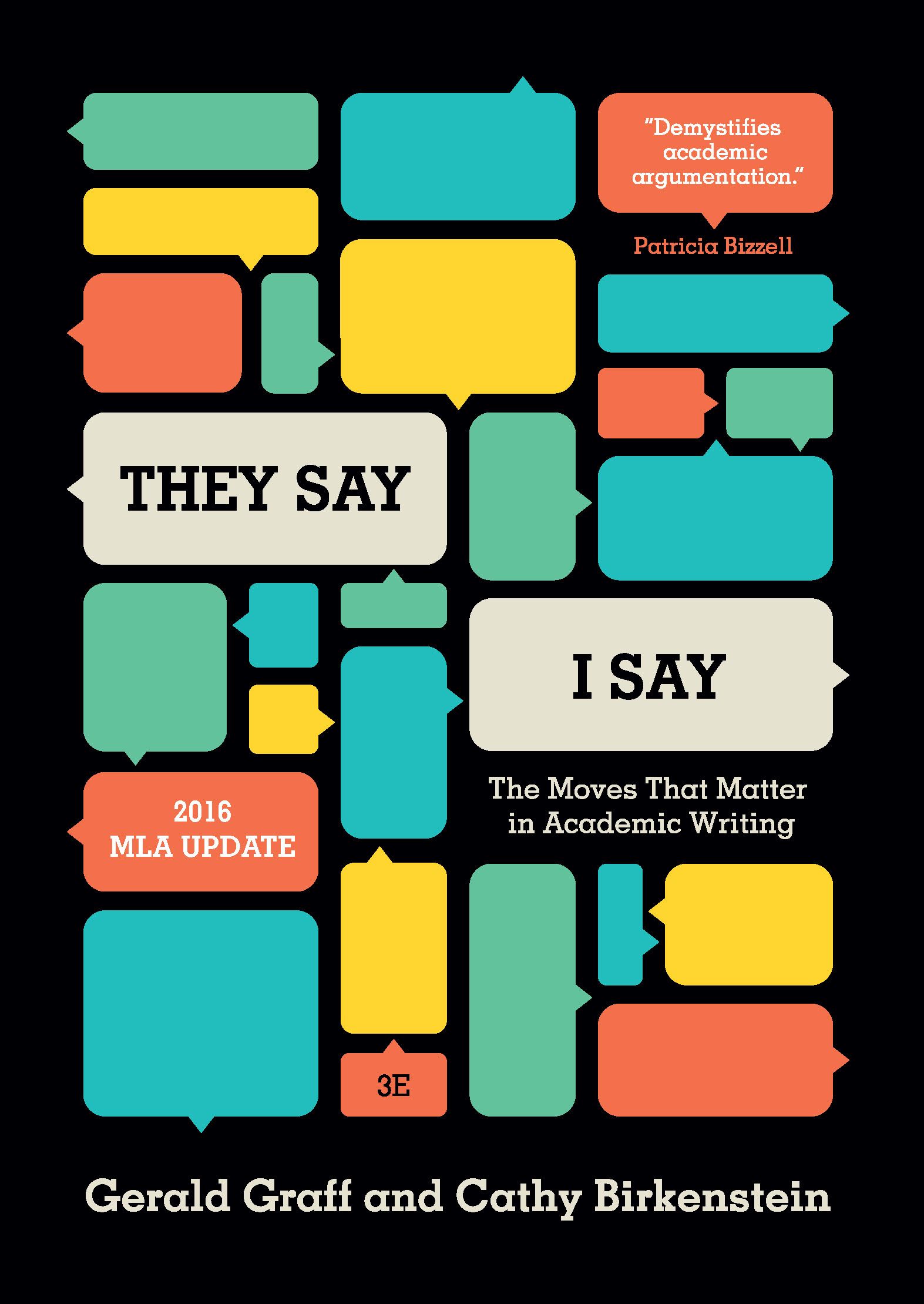
They Say / I Say
Overview
They Say / I Say by Gerald Graff and Cathy Birkenstein is a slim, practical writing guide built around one insight: good writing is always a response. You are never writing into a vacuum. You are entering a conversation, and you have to acknowledge what's already been said before anyone will care what you think.
The book is widely used in college writing courses, but the ideas apply far beyond academia. The templates feel mechanical at first. After a few exercises, you realize they are not a crutch. They are a way to see what your writing is missing.
The Core Framework
They Say — Start by representing the view you are responding to. Summarize it fairly. Do not distort it to make your argument easier.
I Say — Then stake your own position. Agree, disagree, or both. But be clear about which move you are making.
This structure forces two things most writers avoid: actually engaging with opposing views, and being explicit about your own stance.
Key Insights
- All writing is a response. Even when you think you are just sharing your ideas, you are implicitly responding to something. Making that conversation explicit makes your writing sharper.
- Summarizing is harder than it looks. Most people distort the views they summarize, often without realizing it. The discipline of summarizing fairly is the foundation of good argument.
- Templates are scaffolding, not formulas. Phrases like "While X argues that..., I contend that..." feel stilted at first. They exist to make visible the moves that strong writers make invisibly. Once you internalize them, you stop needing them.
- Plant a naysayer. Strong arguments anticipate objections and respond to them directly. If you can't think of a counterargument, you probably don't understand the issue well enough yet.
- "So what?" is the most important question. After you make your point, ask why it matters. Who cares? What is at stake? Many arguments fail not because they are wrong but because they never answer this.
- Metacommentary. Telling readers how to read what you wrote. Phrases like "My point is not X, but Y" reduce misreading and keep your argument on track.
My Takeaways
I started this book because I noticed a gap between how I think and how I write. I have opinions. I can speak them. But when I sit down to write, the argument flattens.
The first exercise — summarize what "they say" — exposed the gap immediately. I kept sliding from summary into my own view without realizing it. That is the collector trap applied to writing: I was not really engaging with the source, I was just using it as a jumping-off point for what I already wanted to say.
The template approach feels unnatural in Vietnamese. In English, it helps. Especially the naysayer move. I tend to skip it because I want to be agreeable. But skipping it makes the argument weaker, not friendlier.
Working through this book as part of a 90-day writing practice. The goal is not to write like an academic. It is to write more clearly, represent ideas more fairly, and have a stronger sense of when I am actually saying something versus when I am just arranging words.